Research Team from Georgia College Explores Coastal Ecosystems at Sapelo Island
Allison Jones | February 2026
A research group from Dr. Kristine White’s marine invertebrate lab recently traveled to Sapelo Island to conduct seasonal field work on coastal crustaceans and the intertidal ecosystems. The trip provided Georgia College students with hands-on experience, while also supporting the ongoing studies of marine biodiversity and environmental monitoring. Located off the coast of Georgia, Sapelo Island is home to The University of Georgia Marine Institute, which provides researchers access to coastal environments and high quality facilities.
The team's main focus was on collecting intertidal amphipods. These small crustaceans play a key role in marine food webs and serve as bioindicators, meaning their presence can reflect environmental conditions. Kali Holierhoek, a student researcher in Dr. White’s lab was studying amphipod diversity and distribution as a part of her thesis. “Amphipods are a super important species,” she said. “A lot of organisms rely heavily on them for food, and they can indicate changes in the environment.” Dr. White explained that tracking species distribution can reveal much broader ecological shifts. “If we can identify all the species and monitor changes in their abundance, it can indicate that something bigger is happening in the ecosystem,” she said. Researchers conducted sampling during spring low tides, using transect methods to shovel and sift measured sections of sand in the intertidal zone. The team also collected subtidal crustaceans using a beam trawl for later lab and molecular analysis.
Elise Mirabella, a student on the trip, is continuing research she began for her past thesis project. Last year, she used a beam trawl to collect subtidal crustaceans from protected and exposed beaches to study seasonal changes in their distribution. The trip provided students with applied training in species identification, field sampling, and experimental design while contributing to conservation knowledge. “If we want to work on conservation, we need to know who is there and their role in the environment,” Kali said. Dr. White emphasized the value of field experience by stating, “Seeing where organisms live and how they interact tells you more than you could ever learn sitting in a lab.” The Sapelo Island trip is part of the lab’s ongoing seasonal research efforts aimed at understanding coastal ecosystems and preparing students for future work in marine and environmental science.
Students and Staff Conduct Research on Water Composition at Lake Oconee and Lake Sinclair
Allison Jones & Camille Tobey | March 2026
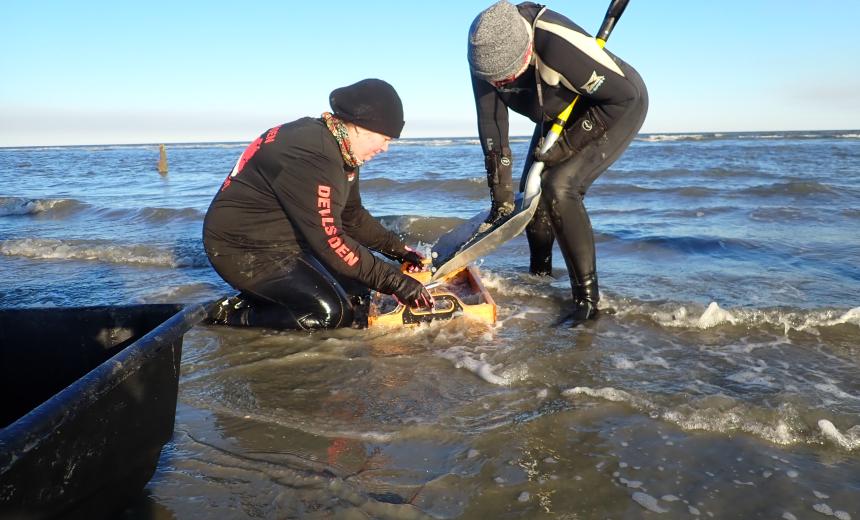
On March 26th, students and staff from Georgia Colleges Aquatic Sciences Center went to three different sites around both Lake Oconee and Lake Sinclair to conduct their monthly research on water composition. At each site, the students collected water samples and recorded key environmental data from three different locations to better understand the water quality of each lake. At every stop, the students followed a consistent sample collection process. First, they carefully labeled each set of three bottles to correspond with what specific site and location they were collecting from. Next, they rinsed each bottle three times with lake water to prevent contamination from previous lab tests. Finally, they collected their samples, making sure to avoid areas in the lake with high sediment levels, as an excess of sediment could skew the results. After collecting their water samples, they also took various measurements with a YSI console. This tool measures water quality indicators such as water temperature, pressure, dissolved oxygen, conductivity, pH level, and turbidity of the water.
The research team is also studying algal blooms and investigating what causes different levels of algae in the lakes, as well as whether blooms can be prevented or predicted. Another focus of the study is the winter drawdown of Lake Sinclair, when water levels are lowered by approximately two meters to allow the lake residents to repair their docks. Researchers are comparing the drawdown lake with non-drawdown conditions to determine whether the lowered water levels had any effect on the overall lake health and water quality.
The overall goal of the research is to establish a baseline for water quality in Lake Oconee and Lake Sinclair. By creating a record of water conditions, researchers will be better prepared to identify changes caused by invasive species or future environmental issues. The project reflects an ongoing commitment to monitoring and preserving the quality of Lake Oconee and Lake Sinclair while also preparing Georgia College students for future work in
aquatic science. Students participating in the research included Anya, an ASC research assistant; Hasari, a graduate assistant; and Michelle, an undergraduate independent studies student.